


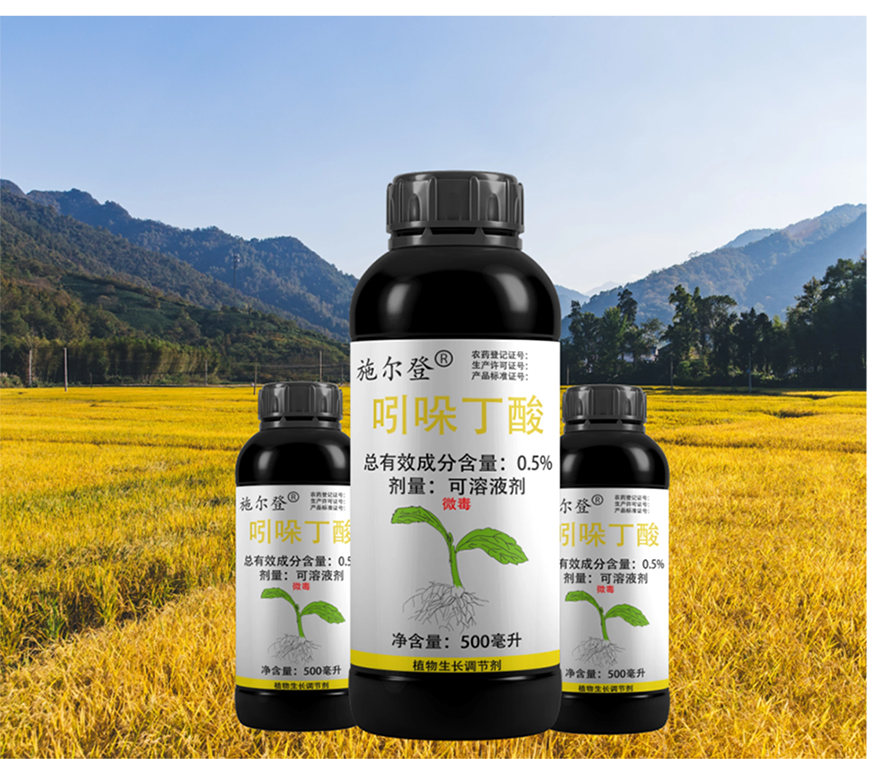
Schr ö dinger ® indolebutyric acid
Core advantage: Based on the 30-year research and development accumulation of Loveland Laboratory in the United States, and in collaboration with Jiangsu Pesticide Research Institute's own chemical production, we have created a full cycle regulation plan of "promoting roots, strengthening seedlings, and increasing yield". The unique formula contains natural plant derived active ingredients and chelated trace elements, which can accelerate root development (increase the number of new roots by 25%), shorten crop life cycle by 7-10 days, and seize market opportunities by being launched early.



Core efficacy
Promoting strong roots and seedlings: activating root meristematic tissue, enhancing nutrient absorption capacity, and increasing seedling survival rate by 20%;
Improving quality and yield: regulating the precise transportation of nutrients to fruits/grains, increasing singlefruit weight by 15%, increasing yield per mu of fieldcrops such as rice and wheat by 12% -18%, and increasing sugar content of fruits and vegetables by 3-5 degrees;
Anti stress adaptation: enhances crop drought and low temperature resistance, suitable for multiple scenarios such as greenhouse cultivation, open field cultivation,and saline alkali land improvement.
Backed by Loveland Lab's30-year plant regulation expertise and optimized for China's climate with Jiangsu Academy of Agricultural Sciences, our tech-empowered formula features natural active ingredients +chelated trace elements toactivate crop growth genes for full-cycle protection.
Stimulates root growth (new roots +25), shortens growth cycle by 7-10 days for early market entry,increases single fruit weight by 15%o, boosts field crop yield by 12%-18%, and enhances fruit sugar content by 3-5Brix for dual improvement in yield and quality.
Enhances multi-dimensional crop resilience-boosts surviva I rate by 20% under <10°C, delays wilting by 6-8 hours under drought, accelerates new root growth by 15% in saline soil, and reduces chlorosis by 30%o. Effectively combats cold, drought, and soil stress, securing yield stability in harsh environments.
Application Period
Small-Scale Fruits and Vegetables:
Seedling Stage
Prevent issues such as dead seedlings, rotten seedlings, stunted growth, damping-off,bacterial wilt,and root rot caused by
diseases or natural disasters.Promote the development of a robust root system and increase the number of fibrous roots.
(Apply twice, with a 15-day interval between applications.)
Vegetative Growth Stage
Enhances photosynthesis, stimulates cell division and elongation, acelerates growth rates, and promotes larger, more tender
leaves-thereby improving yield and quality. Strengthens the plant' s tolerance to cold, drought, and waterlogging, minimizing
the impact of adverse environmental conditions and maintaining optimal growth status.
Pre-Harvest Stage
Applied 10-15 days before harvest, it promotes leaf growth and tenderness while increasing yield.For fruit crops, it boosts fruit
set rates; in crops like strawberries and blueberries,it can advance harvest time by 5-7 days.
Medium to Large Ornamental and Fruit Trees:
Dormant Stage (Winter, November-December)
Enhances stress resistance (cold, drought, etc.) and promotes nutrient accumulation in preparation for the growing season.
New Shoot Stage (Spring, March-April)
Stimulates rapid emergence and growth of new shoots, fostering vigorous branch development to lay a strong foundation for subsequent growth and fruiting.
Pre-Flowering Stage
Facilitates flower bud formation by inhibiting excesive vegetative growth, redirecting nutrients toward reproductive
development, and inducing differentiated flower buds-improving both the quantity and quality of blooms.
Fruit Set & Development Stage
Boosts fruit set rates, promotes uniform fruit development, and induces parthenocarpy (where applicable) to enhance fruit plumpness, consistency, and quality-ultimately increasing single-fruit weight.
Post-Harvest Stage
Suppresses post-harvest vegetative overgrowth (e.g, water sprouts), promotes root development, balances vegetative and reproductive growth, strengthens disease resistance, and delays leaf senescence for sustained tree health.
Usable Range
Vegetables (common varieties)
Tomatoes, tomatoes, eggplants, chili peppers, raw vegetables, spinach, broccoli, asparagus, Dutch millet, sweet rice, mustard greens, baby bok choy, zucchini, bitter millet, silk millet, red radish, cherry ivy, ice cold vegetables, purple blue, white blue
Seedling stage: Promote strong roots and seedlings, shorten the slow seedling stage, enhance stress resistance (such as low temperature and drought tolerance), and reduce the rate of dead seedlings.
Flowering period: Promote flower bud differentiation, increase flowering rate, and reduce abnormal flowers (such as tomato and eggplant to prevent flower drop).
Fruit setting period: prevent fruit drop (such as natural ripening and tomato physiological fruit drop), promote the expansion of the fruiting room, and set fruit earlier.
Swelling period: Accelerate fruit enlargement, improve fruit shape (such as uniform shape of eggplant and chili), and increase single fruit weight.
Maturity period: Promote ripening (accumulation of lycopene), increase sugar content (such as sweet rice and water chestnut), and extend harvesting period (delaying flowering of vegetables and spinach)
Fruit trees
Citrus, Orange, Strawberry, Blueberry, Grape, Cherry, Apple, Pear, Peach, Plum, Apricot, Kiwi, Mango, Litchi, Eyebrow, Pomegranate, Yangmei, Loquat, Cherry, Raspberry.
Sprout period: Break dormancy, promote whole fruit sprouting (such as citrus and grape), and reduce large and small fruits.
Flowering period: Protecting flowers and fruits (such as lychee and eye protection to prevent flower and ear degeneration), improving pollination rate, and reducing physiological fruit drop.
Young fruit stage: Inhibits the formation of abscission layers (preventing young fruit shedding in strawberries and blueberries), promotes cell division, and increases single fruit weight.
Blossoming period: Regulate nutrient distribution (even swelling of grapes and kiwifruit), reduce fruit cracking (lychee and durian), and enhance fruit luster.
Transition period: Promote anthocyanin synthesis (blueberries, grapes), accelerate sugar accumulation (citrus, mango), and mature 7-10 days earlier.
Economic crops (high value-added)
Tobacco, tea, coffee, cocoa, sugarcane, sugar beets, rapeseed, sunflower, cotton, rubber trees, mulberry trees, mint, lavender, rosemary, industrial plants, oil palm, coconut, cashew nuts, swordsman, black clover
Seedling/growth stage: promote thick stems (white cane, rubber tree resistant to lodging), increase branching (cotton, rapeseed promoting fruit branches), extend leaf function stage (tea greening and quality improvement).
Flowering/pod setting period: Improve flowering rate (coffee, cocoa), promote pod/capsule development (rapeseed, sunflower), and reduce empty shell rate.
Maturity stage: Accelerate the accumulation of substances (tobacco leaves thicken, sugar content increases), promote oil synthesis (oil palm, sunflower seeds increase oil content), improve fiber quality (cotton fiber density, strength).
Special regulation: Inhibit tobacco axillary bud germination and reduce nutrient consumption; Regulating the germination rhythm of tea tree shoots to achieve multi batch harvesting.
Medicinal plants
Ginseng, Panax notoginseng, wolfberry, Angelica sinensis, Astragalus membranaceus, Codonopsis pilosula, Polygonatum sibiricum, Scutellaria baicalensis, Radix Isatidis, Magnolia officinalis, Forsythia suspensa, Eucommia ulmoides, Magnolia officinalis, Phellodendron amurense, Eucommia ulmoides, Polygonatum sibiricum, Chrysanthemum morifolium, Salvia miltiorrhiza, and Polygonatum sibiricum.
Seedling/Root and Stem Growth Stage: Promote the development of fibrous roots (Panax ginseng, Panax notoginseng), increase the rate of root and stem swelling (Angelica sinensis, Astragalus membranaceus), Enhance the fresh weight of the root system.
Flowering period/reproductive period: Inhibits premature bolting and flowering (winter prevention of premature aging), concentrates nutrient transport to medicinal parts (goji berry promotes fruiting, silver flower increases).
Maturity stage: Promote the synthesis of active ingredients (increase in content of saponins from Panax notoginseng and Panax notoginseng), delay leaf senescence, and extend the harvest window period (chrysanthemum, Salvia miltiorrhiza).
Anti stress regulation: Enhance shade tolerance (ginseng, ginseng), improve disease resistance (Isatis root resistant to aphid stress), reduce continuous cropping obstacles (decreased incidence of root rot disease in Polygonatum sibiricum and Codonopsis pilosula).