


Detailed explanation of the root system of the six major organs of plants
1、 Concept
Root is a botanical term that generally refers to the underground part of a plant. The main function is to hold the plant body, absorb water and minerals dissolved in water, transport water and minerals to the stem, and store nutrients. The underground structure of many plants is essentially specialized stems (such as corms and tubers), with the main difference between roots and branches being the lack of leaf scars and buds, having a root cap, and branching produced by internal tissues rather than buds.
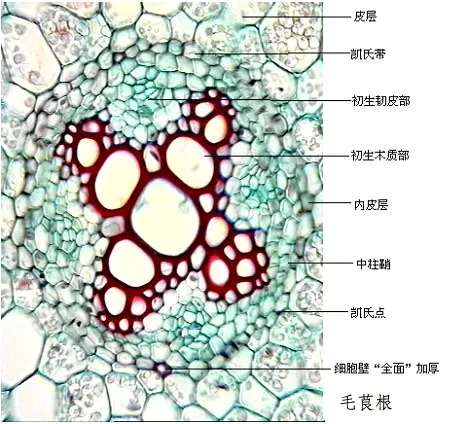
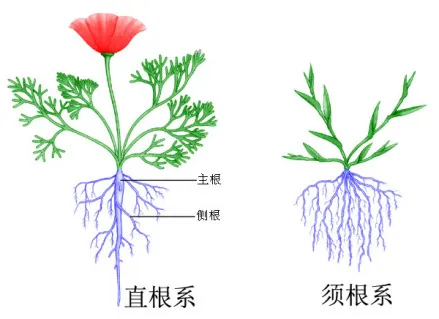
The embryonic root is the first organ that appears after seed germination, and it grows down into the soil to hold the seedling. The embryonic roots of gymnosperms and dicotyledonous plants develop into main roots in the future; The main root grows downwards, while the lateral or secondary roots protrude laterally. This type of root system is called the main root system. Some plants, such as carrots and turnips, have their main roots as storage organs that swell due to the presence of food. Grasses and other monocotyledonous plants have a fibrous root system, characterized by a group of roots with approximately equal diameters; This root network is not generated by the branching of the main root, but contains roots that grow from the base of the stem and have a large number of branches.
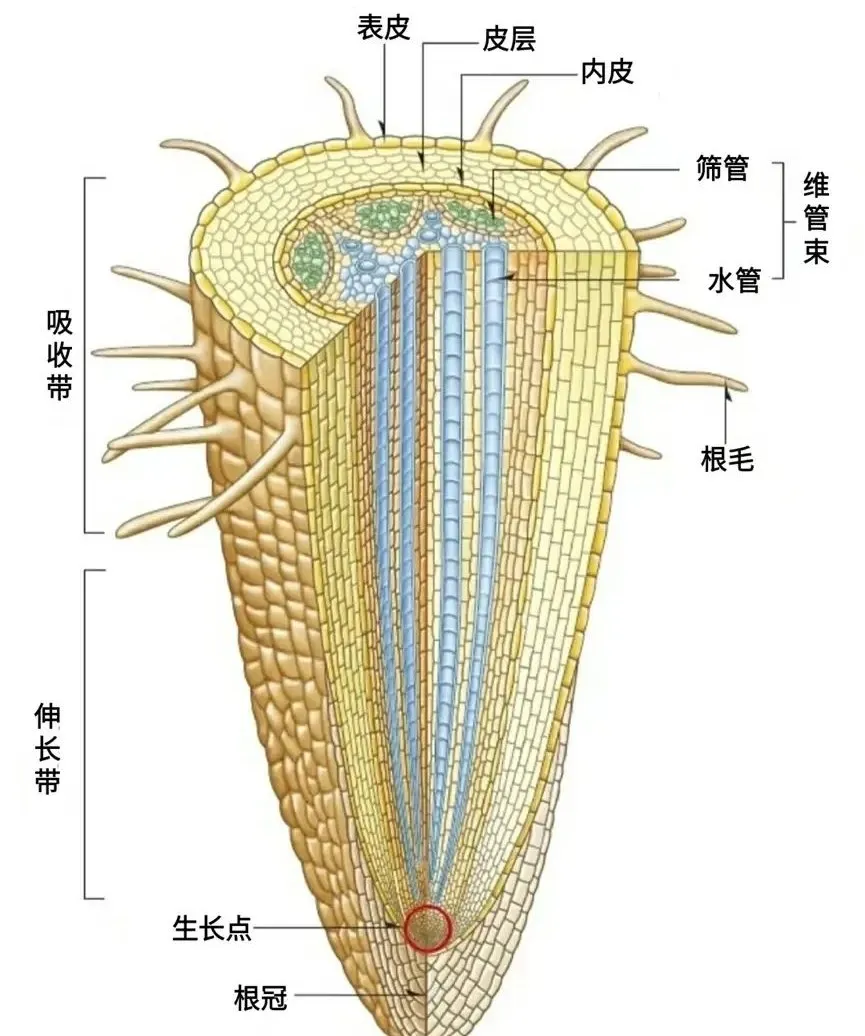
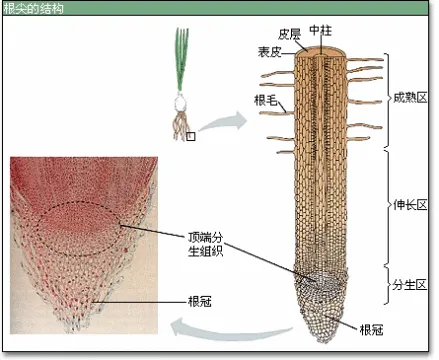
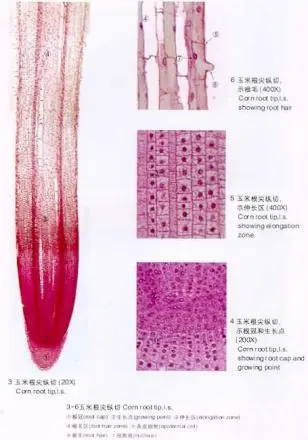
The root only grows from the end and is protected by a needle shaped root cap at the root tip. Behind the root cap is the apical meristem (a group of vigorously dividing cells), where a small portion of the cells produced are added to the root cap and the majority are added to the elongation zone above the meristematic zone (where root growth occurs); Above the elongation zone is the mature zone (where the primary tissue of the root matures and the cell differentiation process originating from the upper meristematic zone is completed). The primary tissue of the root consists of epidermis, cortex, and vascular columns in order from the outside to the inside.
The epidermis is composed of thin-walled cells, usually only one layer thick. Water and water-soluble minerals are absorbed by the epidermis, and most terrestrial plants have root hairs (thin tubes protruding outward from the epidermal cell wall, only found in mature areas) that greatly enhance absorption. The absorption of water mainly relies on permeation, which occurs because:
(1) The water concentration in soil is higher than that in epidermal cells (because the latter contain salts, sugars, and other dissolved organic substances),
(2) The epidermal cell membrane only allows water and does not allow many other substances dissolved in the cell fluid to penetrate.
This situation creates a osmotic pressure difference, allowing water to flow into the epidermal cells. The pressure generated by this flow is called root pressure, which allows water to flow within the roots. Although root pressure is partially responsible for the rise of water in the plant, it cannot alone explain how water is transported to the top of the tree.
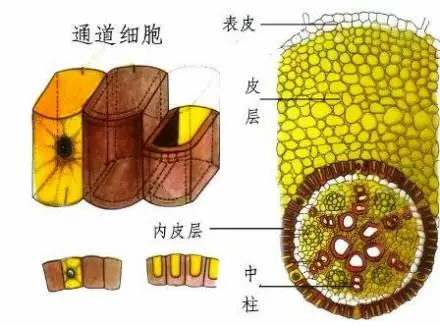
The cortex is responsible for transporting water and water-soluble minerals horizontally from the epidermis to the vascular column, and then from the vascular column to other parts of the plant body. The cortex also stores food transported downwards from leaves through vascular tissues. The innermost layer is usually a tightly arranged layer of cells called the endothelial layer, which can regulate the flow of substances between the cortex and vascular tissues.
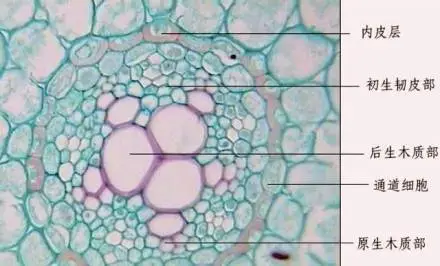
The vascular column is located on the inner side of the endothelial layer and is surrounded by the pericycle (a layer of cells that can grow lateral roots). The transport tissue of the vascular column is usually arranged in a star shape. The xylem is responsible for transporting water and minerals dissolved in water, forming the core of the star shaped structure; The phloem is responsible for transporting nutrients and forming small clusters between the awns of the star shaped body.
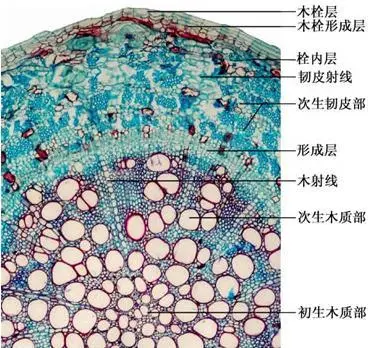
Older roots of woody plants generate secondary tissue to thicken the roots, which is formed by the vascular cambium and cork cambium. The vascular cambium originates from the thin-walled cells between the xylem and phloem, as well as the pericycle cells facing the xylem ridge, and develops into a ring surrounding the primary vascular column; Secondary xylem is produced inward through cell division and secondary phloem is produced outward. The growth of secondary vascular tissue pushes the pericycle outward, causing tearing of the cortex and epidermis. The central sheath then becomes the cork cambium, producing cork cells (outer bark) to replace the cortex and epidermis.
Some roots originate from tissues outside the roots (usually stems, sometimes leaves), especially in underground stems, known as adventitious roots. Many plants can form adventitious roots, so they can reproduce through stem or leaf propagation for nutrition. Roots do not necessarily grow underground. If they grow from the stem and only touch the ground after a certain distance, or remain suspended in the air, they are called air roots; Commonly found in corn, boxwood, and banyan trees, it ultimately helps to retain plants.
2、 Root system
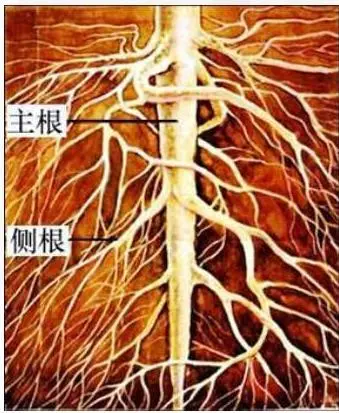
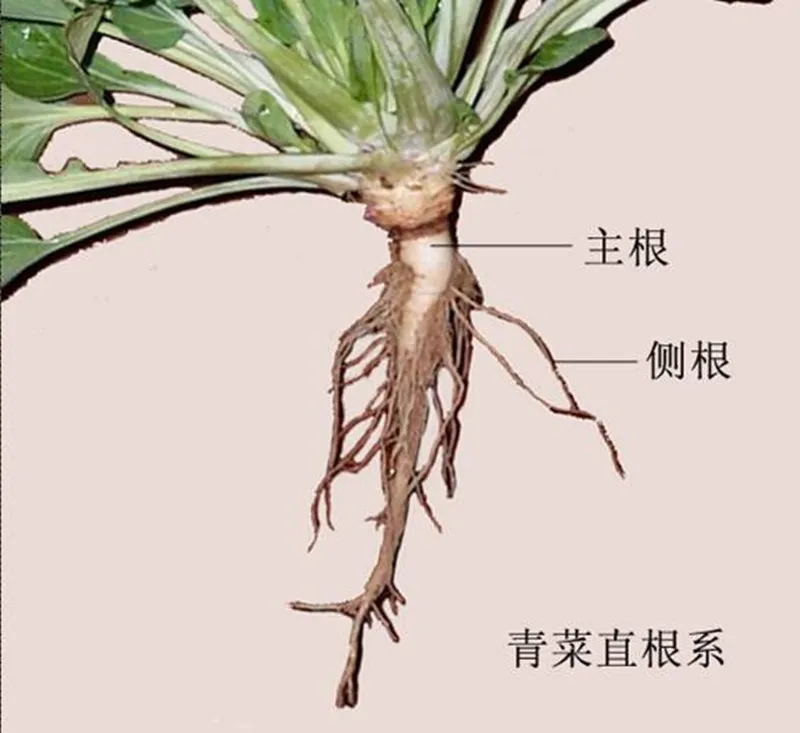
When the seed germinates, the embryonic root develops into a young root that breaks through the seed coat and grows vertically downwards from the ground as the main root. When the main root grows to a certain extent, many lateral roots emerge from its interior, known as lateral roots. Roots that grow on stems, leaves, or old roots other than the main root and lateral roots are called adventitious roots. Repeatedly branching multiple times to form the root system of the entire plant.
The main characteristic of a taproot system is that the main root is significantly thicker and longer than the lateral roots, and lateral roots grow from the main root, with a clear distinction between primary and secondary roots; The main characteristic of the fibrous root system is that there is no significant difference between the main root and the lateral root.
|
root |
taproot and lateral root |
Roots are divided into three parts: root tip structure, primary structure, and secondary structure. The root tip is the tip of the main or lateral root, which is the youngest and most active part of the root, as well as the main part for root growth, elongation, and water absorption. The root tip is divided into root cap, meristematic zone, elongation zone, and mature zone. The fastest growing part of roots is the elongation zone. The cells in the elongation zone come from the meristematic zone.
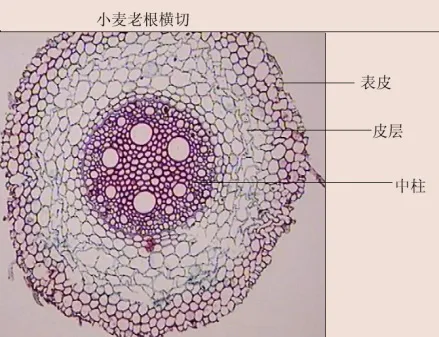
The mature structure of the root is formed by the apical meristem of the root tip through cell division, growth, and differentiation, and this growth process is called primary growth. The various mature tissues formed during the process of primary growth belong to primary tissues, which constitute the structure of roots, that is, the primary structure of roots. If a transverse section is taken from the mature root tip area, the entire primary structure of the root can be observed, which is divided into three parts from the outside to the inside: epidermis, cortex, and vascular column.
The structures formed by the division of cambium cells are distinguished from the primary structures formed by the division of meristematic cells in root tips and stem tips, and are referred to as secondary structures. The root formed by the embryonic root is the main root of the plant. Later, when the plant develops to a certain stage, the activity of the central sheath of the central column produces lateral roots. According to its morphology, it can be divided into axial root system and fibrous root system. The living environment of plants, such as soil conditions and water distribution, and climate conditions, such as humidity and temperature, affect the morphology of roots.
Generally speaking, the depth of the axial root system penetrating into the soil is greater than that of the fibrous root system. The root depth of typical woody plants can reach 10-12 meters. Camel spines living in desert areas can penetrate up to 20 meters underground to absorb groundwater. Monocotyledonous plants, such as those of the Poaceae family, have fibrous roots that penetrate only 20-30 centimeters into the soil. In terms of extended diameter, woody plants can reach 10-18 meters, exceeding their crown diameter. Poaceae plants are only 40-60 centimeters tall. The root absorption area of woody plants can reach 400 square meters.
1. Straight root system
taproot systemThe root system composed of primary roots and secondary roots generated by embryonic root development, with well-developed and distinct main roots that are easily distinguished from lateral roots, is called a taproot system. mostgymnospermanddicotyledonThe root system belongs to the taproot system. Like dicotyledonous plant cottondandelionSoybeanstomatoPeach, etc. Generally, the straight root system penetrates deeper into the soil, and its lateral roots have a wider range of extension in the soil, such aswoody plantThe extended diameter of the root system can reach 10-18 meters, often exceeding several times that of the tree crown;herbLike a pumpkin, its extended diameter reaches 6-8 meters.
2. Beard root system
The main root of monocotyledonous plants stops growing or dies shortly after birth, and many adventitious roots of equal thickness grow on the nodes of the embryonic axis and stem base. Side roots are then generated from the adventitious roots, and the entire root system has a flocculent shape, so it is called the fibrous root system. It is composed of seed roots and adventitious roots. So the fibrous root system is mainly composed of adventitious roots.
For example, wheat is considered a fibrous root system. The main root formed by the growth of embryonic roots is the seed root, which plays a role in absorbing water and providing support during the seedling stage. Generally, it gradually dies after the formation of adventitious roots. Adventitious roots grow from stem nodes, and several adventitious roots will grow on each stem node without elongation. The thicker and more numerous the roots grow on the stem nodes that are higher, and the roots will no longer grow on the stem nodes that are elongated.
3. Indefinite root
It is the root that occurs on the stem or leaf of a plant. In most cases, the occurrence of adventitious roots is due to damage to plant organs or stimulation from external factors such as hormones and pathogenic microorganisms, resulting in plant regeneration reactions. The occurrence of adventitious roots expands the root system of plants, giving them and cells the ability to regenerate, and is widely used in plant organ cuttings and tissue culture.
4. Fake Root
A single or multicellular filamentous root like hyphae that grows beneath the hyphae, penetrates into the matrix to absorb nutrients and support the upper mycelium, presenting a root like appearance. In algae, fungi, lichens, mosses, and some ferns (including the gametophytes of ferns), a root like structure that grows below or at the base of the plant body and has a fixed plant body and weak absorption function.
It is significantly different from the real root. In terms of origin, false roots are derived from the surface or basal cells of the plant body (lichens are derived from the fungal filaments beneath the lichens), while true roots are mostly derived from embryonic roots (main roots), or from pericycle cells (lateral roots), or from stems or leaves (adventitious roots).
Structurally, false roots are very simple, many of which are single-cell structures, such as those found in the original leaves of ferns, ferns, and umbrella algae. Some have multicellular structures, such as gourd moss. Some false roots also form anchoring devices, such as ribbons. Regardless of the type of prosthetic root, there is no vascular tissue inside and no root cap at the tip. The structure of true roots is relatively complex, with vascular tissue inside and a root cap.
The function of true roots is also to fix plant bodies and absorb water and inorganic salts, but their efficiency is much higher than that of false roots. Plants with false roots have a lower level of evolution, while those with true roots have a higher level of evolution.
|
Root apex structure |
Thickening of the inner layer of monocotyledonous plants by five layers |
Cross cutting of old wheat roots |
|
Longitudinal cutting diagram of corn root tip |
Inner layer of monocotyledonous plants |
Secondary Structure of Cotton Old Roots |
3、 The Function of Roots
1. Absorb moisture, inorganic salts
The most active part for the root system to absorb water from the soil is the root hair zone at the root tip. The water absorption phenomenon usually caused only by the activity of the root system is called active water absorption, while the water absorption process generated by the transpiration of the aboveground part is called passive water absorption. The absorption of minerals by roots from soil is an active physiological process, which maintains relative independence from the absorption of water. The most active areas for the absorption of mineral elements by the roots are the root cap and apical meristem, as well as the zone where root hairs occur. Various ions in the soil first adsorb on the surface of roots, then undergo energy conversion and enter the cells through the cell membrane, and then enter the xylem ducts of the vascular column through ion exchange between cells.
The absorption function of roots: One is the active "interception" of soil nutrients by roots. The second is the migration of nutrients from the soil to the root epidermis under the influence of plant growth and metabolic activities such as transpiration and absorption, known as "mass flow and diffusion".
The interception of nutrients relies on the direct absorption of nutrients from the soil in contact with the newly grown roots as they continue to grow.
Due to the transpiration of plants, "mass flow" is a process in which the water potential in the rhizosphere decreases and the nutrients dissolved in the soil migrate to the root surface of the plant along with the soil moisture
Diffusion "refers to the process of nutrients migrating to the root surface through diffusion (free flow), which occurs at a slow speed and over a short distance.
2. Fixed and supportive role
The root system firmly fixes the aboveground part of the plant in the soil.
3. Synthesis ability
The roots can undergo a series of synthesis and transformation of organic compounds. This includes amino acids that make up proteins, such as glutamic acid, aspartic acid, and proline Various plant hormones, such as dragon root growth, acetic acid, cytokinins, and small amounts of ethylene.
4. Storage function

The thin-walled tissue of the root is well-developed and serves as a place for storing substances.
5. Transport function
The transport function is completed by the parts above the root tip. The water and inorganic salts absorbed by root hairs and epidermal cells are transported to the stems and leaves through the vascular tissue of the roots, while the organic matter produced by the leaves is also transported to the roots through the stems, and then transported to various parts of the roots by the vascular tissue of the roots, maintaining the growth and life of the roots.
6. Mycorrhizal fungi and root nodules
Many plant roots have established symbiotic relationships with microorganisms in the soil, forming mycorrhizae or nodules on the plant body. The symbiotic relationship between the roots of certain seed plants and soil fungi is called mycorrhiza. According to the infiltration of host cortical cells by fungi, they can be divided into two types: ectomycorrhiza. Fungi form a sheath layer, known as a hyphal cover, which completely envelops the outer part of young roots. Only a few hyphae invade the intercellular spaces of the root cortex, such as pine trees, oak trees, etc.
Endomycorrhizal fungi form inconspicuous pods, while most hyphae invade the inner cells of the root cortex, such as orchids and strawberries. The hyphae of mycorrhizal fungi act like root hairs, absorbing water and mineral nutrients. It can also convert mineral salts and organic matter in the soil into nutrients that are easily absorbed by the host, as well as produce vitamins to supply the roots.
And the sugars, amino acids, and other organic substances secreted by the host plant can be used for fungal life, so the two are in a symbiotic relationship. The symbiotic relationship between leguminous plants and rhizobia is called rhizobia. The vascular bundles of root nodules are connected to the vascular columns of roots, and the two can exchange nutrients. On the one hand, leguminous plants provide water and nutrients for the growth of rhizobial bacteria On the other hand, rhizobia also fix and synthesize ammonium nitrogen, which is transported to host plants through tissues.
4、 Root's abnormality
In the long-term development process of roots, in order to adapt to changes in the environment, many abnormal morphological structures have emerged, commonly including the following:
1. Storage roots
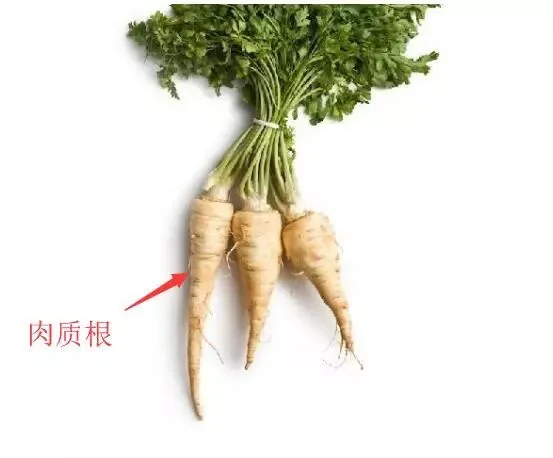
Part or all of the roots are thickened and fleshy, with abundant storageNutrientsThis type of root is called a storage root. According to different forms, it can be divided into:
(1)fleshy taproot:Thickened and fleshytaprootDevelopmental formation, with its upper part havinghypocotylA stem with short internodes and fleshy straight rootslateral rootThinner and shorter. The fleshy taproot can be conical, cylindrical, or spherical in shape.
(2)root tuber:Lateral root oradventitious rootEnlarged or fleshy taproots, formingSpindle shapedOr in chunks, called tubers. in compliance withPolygonum multiflorum ThunbThe lateral roots are enlarged in irregular blocks.
2aerial root
Air roots are roots that grow above the ground and in the airphysiologic functionIt differs structurally from other roots and can be divided into the following types:
(1)brace root:Like corn, some adventitious roots grow from the nodes, and the epidermis often keratinizes,sclerenchymaDeveloped, adventitious roots extend into the soil and continue to produce lateral roots, becoming an auxiliary root system that enhances the plant's support strength. Another example is that banyan trees produce many drooping aerial roots from their branches, and some aerial roots also extend into the soil. Due to futuresecondary growth, becoming thick woody support roots,crown of a treeextendedBanyan treeIt can present a spectacular scene of 'one tree forming a forest'. The roots of plants such as sugarcane also belong to this metamorphosis type.
(2)Climbing roots:Like ivytrachelospermum jasminoideThesoar to the skiesclassA plant stemSlender and weak, unable to stand upright, producing adventitious roots. These roots are flat at the top, some of which become suction cups to fix onto otherstrunkClimbing up the surface of a stone mountain or wall, there is climbingadsorptionTherefore, it is called climbing roots.
(3)respiratory root:Some plants distributed in marshy areas or low-lying coastal areas; For example, the water dragonmangroveThedeciduous cypressWait. In the root system, a portion of the roots grow upwards, exposing themselves to the ground and becoming respiratory roots. Outside the respiratory root, there isBreathing holeThere are developed ones insideaerenchymaIt is conducive to ventilation and gas storage to adapt to the lack of gas in the soil and maintain the normal functioning of plantsGrowth and developmentAdditionally, there are alsosonneratia apetalaPlants such as water dragons.
3Parasitic root
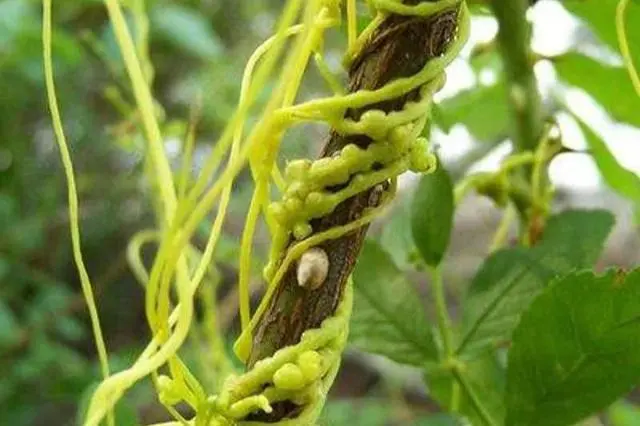
The adventitious roots that produce parasitic effects on plant stems are called parasitic roots, and plants with parasitic roots are called parasitic rootsParasitic plantsParasitic plants can be divided into two types: fully parasitic plants andhemiparasiteA type of plant formed by higher parasitic plants that absorbs nutrients from the host's bodymodificationofroot It is often referred to as a suction device. Parasitic root structure is simple, except for a small amountConducting tissueOutside, there is nothing elseComplex structureLikeDodderThemistletoeParasiticbroomrapeandwitchweed.